



This section provides important information about storage precautions, cargo capacity, and load distribution. Following these guidelines helps ensure safe driving and prevents damage to both cargo and vehicle components.
warning: the following items must not be carried in the luggage compartment because they may pose a fire hazard:
storage precautions
Observe these recommendations to avoid interference with pedal operation, driver vision, or safety in general:
capacity and load distribution
Your vehicle's available cargo capacity depends on the total weight of its occupants. The general calculation is:
cargo capacity = total load capacity − total weight of occupants.
To determine the correct load limit, follow these steps:
For example, if the maximum load is 1400 lbs and five passengers weighing 150 lbs each are in the vehicle, the available cargo capacity is 650 lbs (calculation: 1400 − 750 = 650 lbs).
warning: capacity and distribution
Proper cargo management ensures both the safety of your travels and the longevity of your vehicle's components. Taking the time to secure and evenly distribute your load can prevent accidents, reduce wear on your vehicle, and enhance your overall driving experience.
Calculation formula for your vehicle
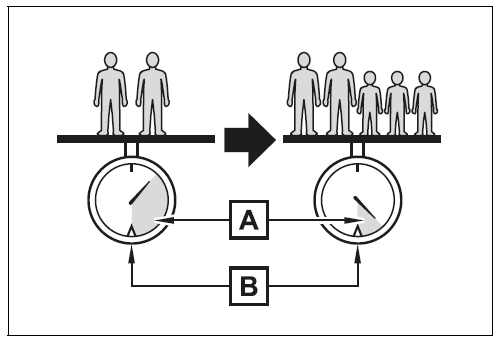
When 2 people with the combined weight of A lb. (kg) are riding in your vehicle, which has a total load capacity (vehicle capacity weight) of B lb. (kg), the available amount of cargo and luggage load capacity will be C lb. (kg) as follows:
B*2 lb. (kg) - A*1 lb. (kg) = C*3 lb.
(kg)
*1:A = Weight of people
*2:B = Total load capacity
*3:C = Available cargo and luggage load
In this condition, if 3 more passengers with the combined weight of D lb. (kg) get on, the available cargo and luggage load will be reduced E lb. (kg) as follows:
C lb. (kg) - D*4 lb. (kg) = E*5 lb.
(kg)
*4:D = Additional weight of people
*5:E = Available cargo and luggage load
 Before driving
 Cargo and Luggage Loading Guidelines and Roof Carrier Precautions
Electric vehicle system
Driving a fully electric vehicle like the Toyota bZ4X offers a unique, eco-friendly, and efficient driving experience. To fully maximize these benefits, it’s essential to understand the advanced Electric Vehicle system features of your car. Our articles provide detailed insights into the innov ...
Using the driving support systems
Explore the full potential of your Toyota bZ4X with intelligent driving support systems designed to enhance safety, comfort, and control. From everyday commuting to challenging road conditions, these advanced features work together to assist you in making smarter, safer driving decisions. Learn how ...

